



TEI/XML and Text Analysis: a Seminar in Language and Social Research
Reported by Rafli Izzuddin
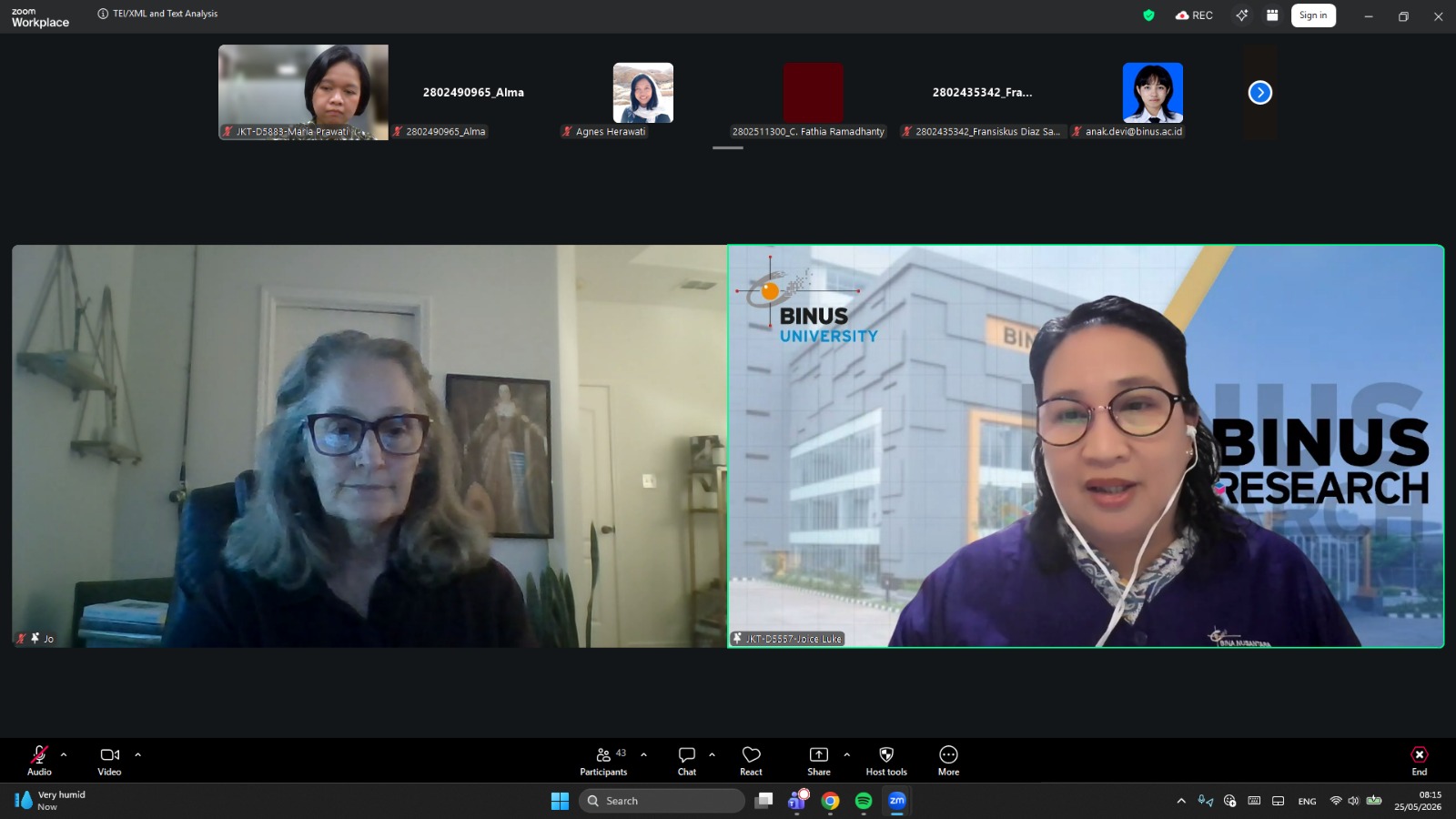
On 25 May 2026, an online seminar in language and social research was held by BINUS CDE, specifically on text analysis using the humanities-centric markup language known as Text Encoding Initiative (TEI). Dr. Joice Yulinda Luke served as the moderator, with Jo McIntosh, Ph.D. from Concordia University Texas as the speaker. All who were present for the event attended through Zoom.
McIntosh began her presentation by identifying flaws within plain text, one of them being its ‘flatness’, a limitation inherent to the format. She touted TEI as a way to eliminate this limitation by augmenting the text with varying tags, making any overall work more searchable by database. The example she used was of her dissertation: a digital edition of The First Part of the Countess of Montgomery’s Urania, a romance written and published in 1621 by Lady Mary Wroth, one of the first known English prose to have been written by an English woman.
When the presentation ended and the Q&A session began, yours truly asked McIntosh a question: was the process smooth sailing? She admitted that she had a lot of difficulty at first, citing her pride as an obstacle as she tried to do everything herself at first. It was not until later that she relented and recruited volunteers – both lecturers and students – to assist her with the coding. From there, everything progressed much more smoothly.
Despite the benefits TEI provided McIntosh, it took her knowing both herself – or rather, her limits – and others to make the markup language truly shine for her dissertation. No matter the method, meaningful scholarly work still depends on adaptability and collaboration.
Comments :